10 UX books every designer should read
Tools change every year. Good books on design, research and people don't. These are the ten I recommend most, who each one is for and the single idea I took from it.
Design tools change so fast that a tutorial from two years ago can feel ancient. Books are different. The best ones are about people, how they think, decide and get confused, and people haven't changed much at all.
These are the ten books I recommend most often to designers, from first-year juniors to leads. I've grouped them by what they help you do, and for each one I've shared the idea that stuck with me.
Foundations
1. The Design of Everyday Things, by Don Norman
The classic. Norman explains why we struggle with doors, stoves and software, and why it's almost never the user's fault. He introduces ideas like affordances, signifiers, feedback and mapping that every designer still uses.
The idea that stuck: when people make mistakes, look for the design that invited the mistake. Blaming users is the easy way out.
2. Don't Make Me Think, Revisited, by Steve Krug
Short, funny and endlessly practical. Krug shows how people really use websites: they scan, they guess and they muddle through. It's the fastest way to learn the basics of usability, and you can read it in an afternoon.
The idea that stuck: every question mark in a user's head adds to their workload. Remove as many as you can.
3. Laws of UX, by Jon Yablonski
A clear, compact guide to the psychological principles behind good design, from Jakob's Law to the peak-end rule. Each chapter explains the principle, shows examples and covers where it applies.
The idea that stuck: having names for these principles makes design feedback far more convincing.
Research
4. Just Enough Research, by Erika Hall
The perfect antidote to the idea that research needs big budgets and long timelines. Hall makes the case for doing focused research to answer real questions, and explains how to do it well.
The idea that stuck: research is about reducing the risk of being wrong, not about proving you're right.
5. The Mom Test, by Rob Fitzpatrick
Written for founders, but every designer who talks to users should read it. It explains why people lie to you in interviews, kindly and without meaning to, and how to ask questions that get honest answers.
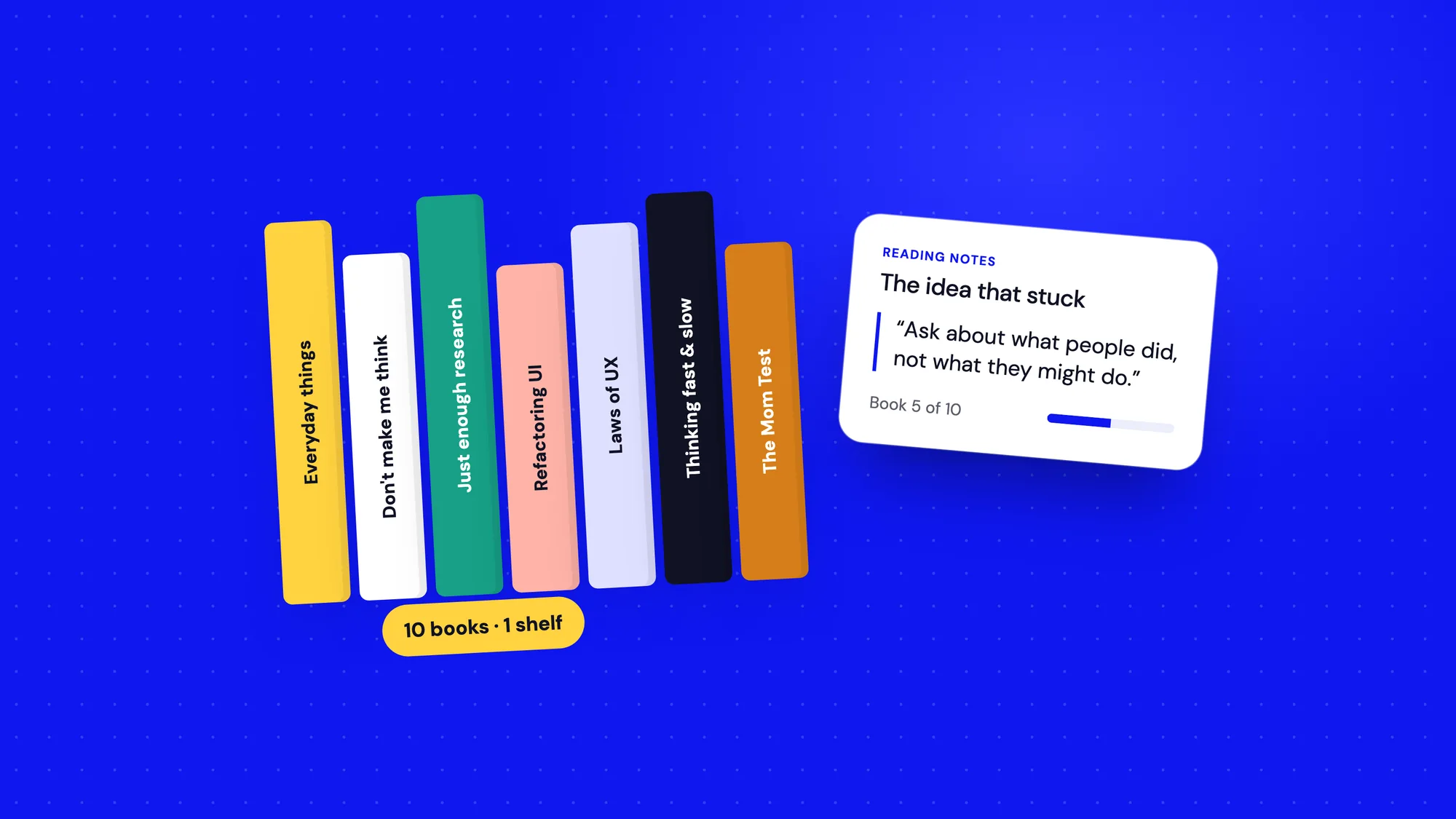
The idea that stuck: ask about what people did in the past, not what they might do in the future. Opinions are cheap. Past behaviour is evidence.
6. Continuous Discovery Habits, by Teresa Torres
A practical guide to talking to customers every week, not just at the start of a project. Torres introduces the opportunity solution tree, a simple way to connect what you learn to what you build.
The idea that stuck: small, regular contact with customers beats occasional big studies.
Craft
7. Refactoring UI, by Adam Wathan and Steve Schoger
If your designs look "almost right" but you can't say why, this book is for you. It's full of before-and-after examples on hierarchy, spacing, colour and typography, written for people who build interfaces.
The idea that stuck: start with too much white space, then remove it. It's easier than adding space to a cramped design.
8. Strategic Writing for UX, by Torrey Podmajersky
Words are a huge part of any interface, and this book treats them that way. Podmajersky gives clear frameworks for writing buttons, errors, onboarding and notifications that match your product's voice.
The idea that stuck: write interface text as a conversation. If it sounds odd said out loud, it'll read oddly on screen.
Working with people
9. Articulating Design Decisions, by Tom Greever
Great design dies in meetings all the time. Greever shows how to present your work, listen to feedback and explain your choices in a way stakeholders understand and support.
The idea that stuck: the best designers aren't just good at design. They're good at explaining it.
10. Thinking, Fast and Slow, by Daniel Kahneman
Not a design book, but one of the most useful a designer can read. Kahneman, a Nobel prize winner, explains the two systems that drive how we think: one fast and intuitive, one slow and deliberate. Most interfaces are used by the fast one.
The idea that stuck: people rarely read and reason carefully. Design for quick, intuitive judgement first.
Honourable mentions
Ten was a hard limit. These almost made the list and are well worth your time once you've read the core ten.
- About Face, by Alan Cooper and others: a deep reference on interaction design, especially for complex software.
- Atomic Design, by Brad Frost: the clearest explanation of how to think about design systems as building blocks.
- Sprint, by Jake Knapp: a step-by-step guide to the five-day design sprint, useful even if you never run a full one.
- Inclusive Design Patterns, by Heydon Pickering: practical accessibility for common interface components.
Where to start
- New to UX: start with Don't Make Me Think, then The Design of Everyday Things.
- Want to do more research: Just Enough Research and The Mom Test.
- Want your work to look better: Refactoring UI.
- Moving into a senior role: Articulating Design Decisions and Continuous Discovery Habits.
A simple 12-week reading plan
If you'd like structure, here's a plan that works around a full-time job. It assumes about twenty minutes of reading a day.
- Weeks 1 to 2: Don't Make Me Think. Then review one of your own screens with Krug's eyes.
- Weeks 3 to 5: The Design of Everyday Things. Look for affordances and signifiers in the products you use every day.
- Weeks 6 to 7: Just Enough Research and The Mom Test. Run three short interviews using what you learned.
- Weeks 8 to 9: Refactoring UI. Redesign one old project and compare the before and after.
- Weeks 10 to 12: Articulating Design Decisions. Use its techniques in your next presentation.
The others fit around this as your work needs them. Laws of UX makes a great companion to any of them, because each chapter takes just a few minutes.
How to get the most from a design book
Reading a book once and putting it on the shelf rarely changes anything. A few habits help the ideas actually show up in your work.
- Read with a current project open, and note where an idea applies.
- Write a one-page summary in your own words when you finish. You'll remember far more.
- Pick one idea and use it in your next design review.
- Reread your favourites every couple of years. You'll notice different things as you grow.
The best design books don't teach you a tool. They teach you to see people more clearly.